Burst Pipe Repair & Cleanup in Magnolia, AR: Full Guide
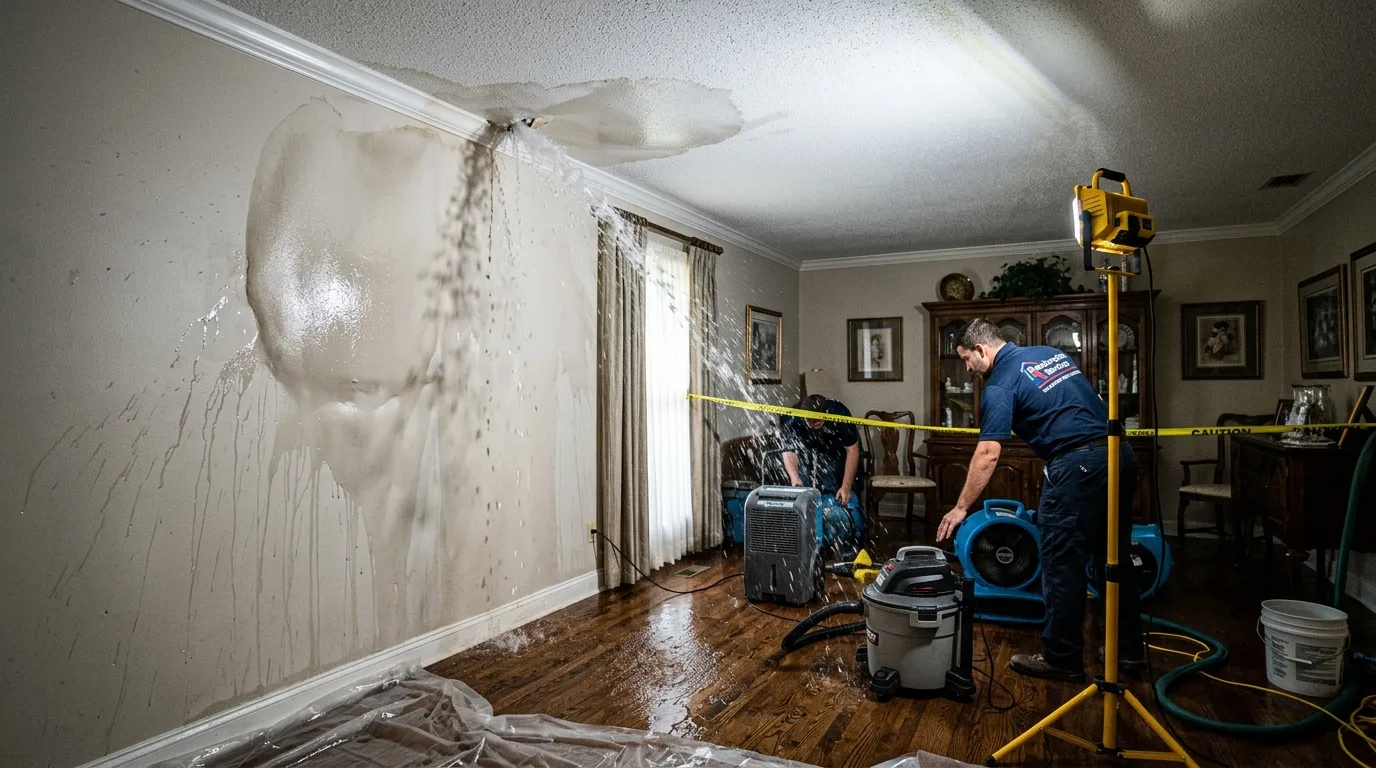
By January in Magnolia, dozens of Columbia County homeowners have already dealt with burst pipes during a winter cold snap. The freeze comes overnight, the pipe cracks while the household sleeps, and by morning several inches of water have accumulated in a room — or inside a wall where it won’t be discovered until a soft floor or stained ceiling makes the damage unmistakable. This guide covers what to do immediately after a burst pipe, how cleanup works, what it costs, and how to prevent it from happening again.
Burst Pipe in Your Magnolia Home? Call Now.
Shut off the main water supply, then call (877) 698-1311. We dispatch within 60 minutes throughout Columbia County.
Why Burst Pipe Cleanup in Magnolia Requires Immediate Action
Burst pipe repair and cleanup in Magnolia follows a clear cost-time relationship: every hour the water runs undetected, repair costs increase. A supply line releasing water at full pressure inside a wall cavity for 8 hours overnight will saturate wall framing, insulation, subfloor, and potentially the ceiling of the room below — converting what might have been a $4,000 cleanup into a $10,000–$15,000 project.
The winter freeze pattern in Magnolia makes overnight discovery common. Temperatures in Columbia County typically drop below freezing during December through February cold snaps — rarely for extended periods, but enough to freeze supply pipes in exterior walls, crawlspaces, and attic-adjacent areas. Many homes in the N Washington and Freaktown neighborhoods were built without the pipe insulation that colder-climate homes take for granted, because Magnolia’s winter freezes are infrequent enough that insulation was considered optional.
Older homes near the Columbia County Courthouse and in Magnolia’s historic districts often have galvanized steel supply pipes — material that becomes increasingly brittle over decades and fails at freeze stress that newer copper or PEX pipes might survive.
Types of Burst Pipe Events
Freeze-burst: The most common winter event — water in the pipe freezes, expands, and cracks the pipe wall. The burst typically occurs at the point where the frozen section meets unfrozen pipe under pressure.
Pressure-failure burst: An aged or corroded pipe that has been carrying water under full supply pressure eventually fails at a weak point — a corroded section, an old soldered joint, or a stress fracture that has been propagating slowly.
Supply line failure: Braided steel or plastic supply lines connecting toilets, sinks, and appliances have a finite lifespan. When these fail, they can release water at full supply pressure directly into a cabinet or under a floor.
Fitting failure: Plumbing joints — threaded fittings, soldered connections, compression fittings — can fail over time, releasing water inside walls where it may go undetected for hours or days.
How Burst Pipe Cleanup Works
Step 1: Shut off water and call immediately. The main shutoff valve is typically at the water meter (often in a covered box near the street) or where the main line enters the home. Shut off power to affected areas at the breaker panel if water has contacted or may contact electrical outlets or fixtures. Then call a water damage restoration team and a licensed plumber simultaneously.
Step 2: Moisture assessment. Our technicians arrive with thermal imaging cameras and penetrating moisture meters to map the full extent of water penetration. Thermal imaging is critical for burst pipe events because water travels significant distances along framing and subfloor before becoming visible — a burst in a second-floor wall may have pushed water down to the first-floor subfloor and below.
Step 3: Extraction. Truck-mounted extraction removes standing water. Wand extraction removes water from carpet, pad, and flooring. Wet materials are assessed for salvageability — some carpet and pad, heavily saturated insulation, and sections of drywall will be removed to expose structural framing for drying.
Step 4: Structural drying. Commercial air movers and dehumidifiers run continuously for 3–7 days with daily moisture monitoring. Antimicrobial treatment is applied to exposed wood framing to prevent mold growth during the drying phase.
Step 5: Reconstruction. After drying is confirmed by moisture meters, reconstruction begins — drywall, insulation, flooring, and cabinetry replaced as needed. We coordinate with the licensed plumber on repair timing.
Burst Pipe Cleanup in Magnolia — We Handle Everything
Call (877) 698-1311 for 24/7 emergency dispatch throughout Columbia County. IICRC-certified, insurance documentation included.
Practical Uses for Burst Pipe Preparation
- Install a water shut-off sensor: A leak detector near the main water line with an automatic shutoff can limit burst pipe damage to minutes rather than hours — especially valuable for Columbia County homeowners who travel during winter
- Insulate exterior wall pipes before winter: Focus on pipes running through exterior wall cavities, crawlspaces, and attic-adjacent areas — the most common freeze points in Magnolia homes
- Know your main shutoff location: Walk your household through where the main shutoff is before you ever need it
- Check supply line ages: Washing machine hoses and toilet supply lines should be replaced every 5–7 years; stainless braided hoses every 10 years
- Set thermostat to 55°F minimum during travel: Even during Magnolia’s mild winters, overnight temperature drops can freeze exposed pipes if heating is turned off completely
Cost of Burst Pipe Cleanup in Magnolia
Burst pipe water damage cleanup in Magnolia costs $3,500–$15,000 depending on how much water was released and for how long. A pipe burst discovered within an hour typically costs $3,500–$5,000 for cleanup; overnight events affecting multiple rooms run $8,000–$15,000. The Columbia County average for residential pipe burst cleanup is $3,500–$7,000, at $14–$17 per square foot of affected area.
Homeowners insurance in Arkansas typically covers burst pipe damage as a sudden and accidental event. We document the event thoroughly — thermal images, moisture logs, photos — to support your claim.
Frequently Asked Questions
How do I know if a pipe has burst inside my wall?
Common signs of a wall-cavity burst include: sudden and unexplained drop in water pressure throughout the home, bubbling or staining on drywall, wet spots on floors adjacent to walls, soft or spongy drywall when pressed, and a running water sound with no fixture turned on. Thermal imaging can locate hidden moisture with certainty. Magnolia homeowners in Blake Barker and Magnolia South neighborhoods with older galvanized plumbing should be especially watchful during winter cold snaps.
My pipe burst while I was away — how bad is it likely to be?
A burst that ran undetected for 8+ hours is a significant water damage event. Expect moisture to have penetrated wall framing, insulation, subfloor, and possibly the ceiling of the floor below. Many materials that would have been salvageable with fast response will need to be removed. A thermal imaging assessment will establish the full extent. For guidance on next steps, see our complete guide to water damage restoration in Magnolia.
Can I dry the walls myself after a burst pipe?
Household fans move air but do not remove moisture from structural materials — they can actually spread airborne mold spores if mold has begun growing. Effective structural drying requires commercial air movers calibrated to the affected square footage, dehumidifiers removing moisture from the air, and daily moisture monitoring to verify progress. DIY drying after a burst pipe almost always produces residual moisture in framing and subfloor that leads to mold growth weeks after the visible water is gone.
Burst Pipe Damage? Magnolia Water Damage Restoration Has You Covered.
IICRC-certified, 24/7 emergency response throughout Columbia County. Call (877) 698-1311 now.
Related: