Mold Remediation After Water Damage in Magnolia, AR
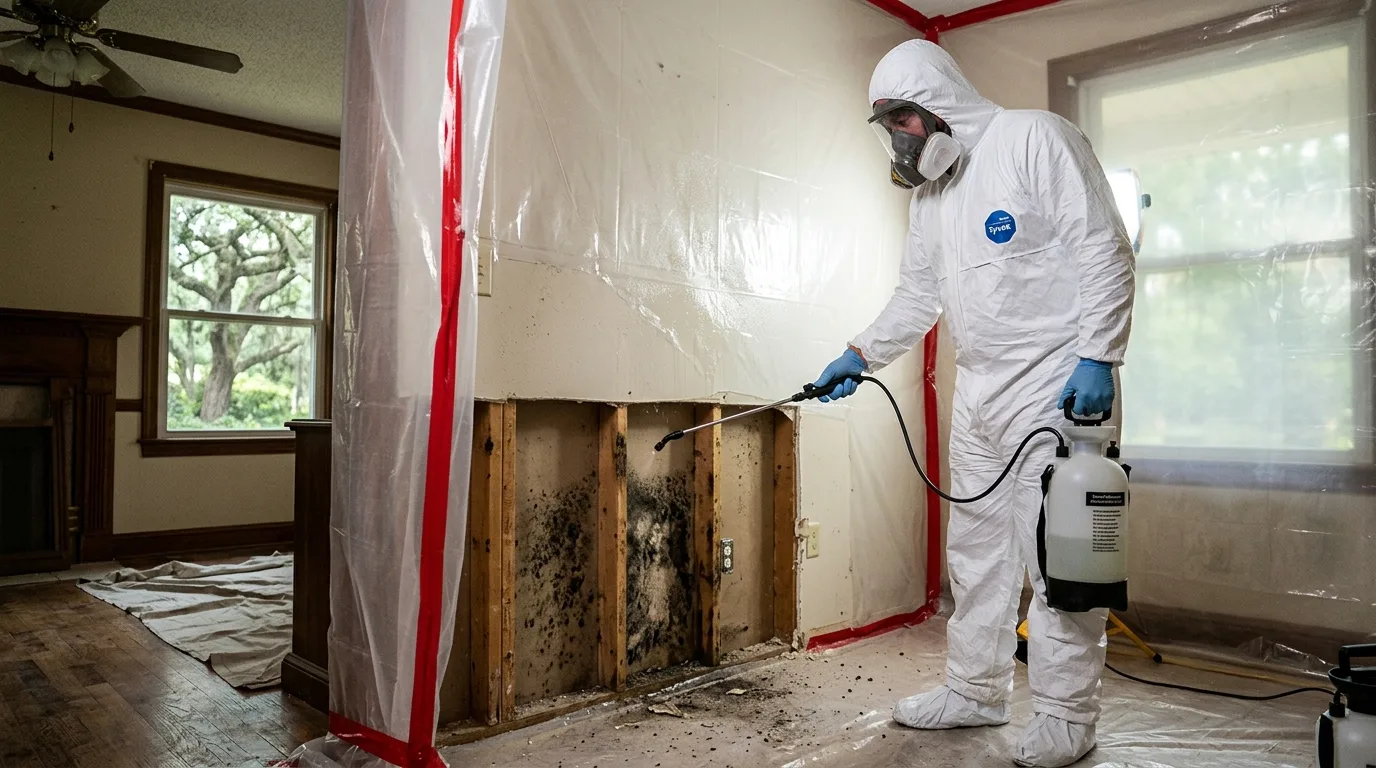
Water damage that isn’t addressed within 24–48 hours in Magnolia’s climate doesn’t just stay wet — it becomes a mold problem. This guide explains how mold develops after water damage events, what IICRC-certified remediation involves, what it costs for Columbia County homeowners, and how to tell whether a water damage event has already produced mold growth you can’t see.
Mold After Water Damage in Magnolia? Get a Free Assessment.
Call (877) 698-1311 for same-week mold assessment throughout Magnolia and Columbia County.
Why Water Damage Leads to Mold in Magnolia Homes
Mold remediation after water damage in Magnolia is needed more frequently than in drier climates because of a specific environmental reality: Magnolia’s humid subtropical climate provides ideal mold germination conditions for most of the year. With average July high temperatures reaching 93°F and summer relative humidity regularly above 70%, a water-damaged structure in Magnolia offers mold exactly what it needs — moisture, warmth, and organic material (drywall, wood, carpet) — immediately after a water event.
In scientific terms, mold begins germinating from airborne spores within 24–48 hours when surface moisture exceeds a critical threshold and temperature is above roughly 55°F. In practical terms for Magnolia homeowners: if water entered your home during spring storm season and cleanup didn’t begin within 48 hours, mold has almost certainly begun developing in the affected areas. The visible signs — black, green, or white patches on walls and ceilings — often appear 5–7 days after the initial event, but colony development begins much earlier inside wall cavities and under flooring where it can’t be seen.
Properties in the Midtown Magnolia neighborhood and throughout the Freaktown historic area deal with an additional factor: older home construction with less moisture-resistant drywall and limited wall cavity ventilation. These materials support mold growth faster than modern construction with paperless drywall and tighter building envelopes.
Types of Mold Found After Water Damage
Surface mold on drywall and framing: The most common post-water-damage mold in Magnolia homes — visible growth on wall surfaces, behind cabinets, and in attic spaces. Often remediable without full wall demolition if caught within the first 1–2 weeks.
Mold in wall cavities: Mold growing on the paper face of drywall or on wood framing inside wall assemblies — common when water entered through a burst pipe or roof leak and wasn’t visible until the wall surface showed staining. Requires targeted demolition and remediation.
Crawlspace mold on floor joists: Extremely common in Magnolia due to clay-soil hydrostatic moisture intrusion. Visible mold on floor joists and subfloor is a sign of ongoing elevated humidity in the crawlspace, often present long before a homeowner notices symptoms. See our guide on why Magnolia’s clay soils mean more crawlspace water problems.
HVAC mold: When a flood event or high-humidity period allows mold to colonize air handler components or ductwork, spores distribute throughout the home every time the system runs. Identifiable by musty odors from vents during HVAC operation.
How Mold Remediation Works
Assessment and air sampling: A qualified technician inspects the home, takes moisture readings, and collects air samples to determine mold species, concentration, and extent of growth. This establishes the remediation scope.
Containment: Affected areas are isolated using polyethylene sheeting and negative air pressure systems with HEPA filtration. This prevents spore dispersal to unaffected areas during the remediation process — critical in Magnolia’s homes where HVAC systems can rapidly distribute disturbed spores.
Material removal: Contaminated materials — drywall, insulation, carpet, vapor barriers — are removed, double-bagged, and disposed of properly. Structural wood with surface mold can sometimes be remediated in place using HEPA vacuuming and antifungal treatment; deeply colonized wood may require replacement.
Cleaning and treatment: Remaining structural surfaces are HEPA-vacuumed, cleaned with antimicrobial agents appropriate for the mold type identified, and in some cases treated with encapsulants that seal porous surfaces against future growth.
Post-remediation clearance testing: An independent air sample test confirms that airborne mold spore counts have returned to background levels before containment is removed. This clearance documentation is essential for insurance claims and future property sales.
Visible Mold in Your Magnolia Home?
Call (877) 698-1311 for IICRC S520-certified mold remediation throughout Columbia County. Same-week scheduling available.
Practical Prevention Steps After Water Damage
- Begin extraction within 24 hours: The window to prevent mold after a water event is 24–48 hours — after that, mold remediation becomes part of the restoration scope
- Verify drying completion before closing walls: Never reinstall drywall or flooring until moisture readings confirm structural materials are at IICRC drying targets — not just “feels dry”
- Address crawlspace moisture independently: Even a successful above-grade restoration can be undermined by crawlspace mold driven by ongoing clay-soil moisture — check crawlspace conditions after every significant water event
- Improve crawlspace vapor barriers: For Magnolia homes with clay-soil moisture intrusion, upgrading to a reinforced 20-mil vapor barrier and adding a sump pump dramatically reduces ongoing mold risk
- Run dehumidifiers during summer: Keeping indoor relative humidity below 50% during Magnolia’s humid summer months prevents ambient mold growth independent of water events
Mold Remediation Costs in Magnolia
Mold remediation in Magnolia costs $1,500–$15,000 depending on scope. Single-room surface mold removal runs $1,500–$3,500; whole-home events involving multiple rooms or HVAC contamination cost $8,000–$15,000. Crawlspace mold remediation typically adds $1,500–$4,000 to the overall project cost depending on joist and subfloor involvement.
Homeowners insurance often covers mold remediation costs when the mold resulted directly from a covered water damage event — burst pipe, roof leak, or appliance failure. Flood-related mold requires flood insurance coverage. We document the causal relationship between the water event and mold growth for insurance purposes.
Frequently Asked Questions
How do I know if mold is growing in my Magnolia home after water damage?
Visible signs include dark patches on walls, ceilings, or under sinks; musty odors that persist after visible water is removed; and health symptoms (respiratory irritation, allergic reactions) that improve when occupants leave the building. In Columbia County homes with crawlspace moisture issues, musty odors rising through floors are a common indicator of active joist mold. A professional air quality test provides definitive results — visual inspection misses mold growing inside wall cavities.
Can I clean mold myself after a water damage event?
Surface mold on non-porous surfaces (tile, metal, glass) can be addressed with appropriate cleaners. Mold on porous materials — drywall, wood framing, insulation, carpet — cannot be effectively removed by surface cleaning; the mold penetrates the material and regrows from subsurface mycelium. Professional remediation with HEPA containment, material removal, and clearance testing is required for mold on porous structural materials. DIY cleaning of visible mold may also disturb spores and distribute them more widely through the home.
Will mold come back after remediation?
Mold will not recur if the moisture source that caused growth is eliminated and remediation is completed to IICRC S520 standards. In Magnolia, the most common cause of mold recurrence is inadequately addressed crawlspace moisture — clay-soil hydrostatic pressure that continues pushing moisture into the structure after the visible mold event is remediated. We identify and address the moisture source as part of every remediation, not just the mold itself.
Mold After Water Damage in Magnolia — We Fix Both.
IICRC-certified water damage restoration and mold remediation by Magnolia Water Damage Restoration. Call (877) 698-1311 for a free assessment.
Related: